Greek lives
Aristotle Onassis: from Smyrna to the shipping lanes of the world
A refugee at sixteen, a supertanker at forty-seven, an airline and an island: the Onassis story.

Photo Credit
Image courtesy of © Tomisti · CC BY-SA 4.0 via Wikimedia CommonsAristotle Onassis fled burning Smyrna at sixteen, built a tobacco business in Buenos Aires, bought two old cargo ships in 1933 and ended as the most famous shipowner of the century. His will founded the Onassis Foundation, whose Athens stage, Onassis Stegi, is where the story meets the visitor today.
Start at Onassis Stegi on Syngrou Avenue, the foundation’s performance and arts house, if a production or exhibition fits your dates. The Onassis Library, a 1905 neoclassical house at 56 Amalias Avenue, keeps objects from his Monte Carlo and Paris offices, furniture from his yacht Christina and a piano Maria Callas once played; visits and tours are by request through the foundation’s contact form, and its talks and events are free.
Between them they give a living meaning to a name that once appeared on tankers, an airline and the society pages.
A refugee with a Nansen passport
Onassis was born in Smyrna, now İzmir, in January 1906, the son of a well-to-do tobacco merchant. In September 1922, aged sixteen, he watched the city burn from the bridge of a ship and fled with hundreds of thousands of Greek refugees to Athens, where the family settled. In August 1923 he sailed for Argentina on a Nansen passport, the document issued to stateless refugees.

Photo Credit
Image courtesy of © StrangeTraveler · CC BY-SA 4.0 via Wikimedia CommonsTobacco, then ships
In Buenos Aires he worked nights as a telephone operator, then in 1924 founded an import-export company selling lighter Near Eastern tobacco to a new market, women smokers. By 1932 he had £50,000. That year he turned to shipping, and in 1933, in the depths of the Depression, he bought two Canadian cargo ships, First World War veterans lying in the St Lawrence, for £3,775 each. He named them after his parents.
Tankers, Monte Carlo and an airline
He was the first Greek shipowner to bet on tankers, launching the Ariston in Sweden in 1938. In 1953 he built his first supertanker in Hamburg and took control of the Société des Bains de Mer, owner of the Monte Carlo casino, and in 1954 Monte Carlo became his centre of operations. In 1956 he took over Greece’s ailing national airline, and Olympic Airways began flying on 6 April 1957.
In 2000 Lloyd’s List named him the world’s leading shipowner of the 20th century.

Photo Credit
Image courtesy of © Tomisti · CC BY-SA 4.0 via Wikimedia CommonsSkorpios
In 1963 he bought Skorpios, a small, bare island opposite Lefkada, and made a private paradise of it: trees, guesthouses, harbours, beaches and a farm. Maria Callas, with whom he had a long relationship, spent the summer of 1964 there. In 1968 he married Jacqueline Bouvier Kennedy on the island. The island is private, and he is buried there beside his son.
The two old ships he bought in 1933 were named for his parents. Everything after them was named for ambition.
The legacy in Athens
His son Alexander died in 1973, and Onassis died in Paris on 15 March 1975. His handwritten will founded the Alexander S. Onassis Public Benefit Foundation, which now works in culture, education, health and the environment. The fortune made by moving oil across oceans now moves ideas around Athens instead, which may be the most unexpected cargo of his career.
Why it's on our list
- A refugee with a Nansen passport
- Tobacco, then ships
- Tankers, Monte Carlo and an airline
- Skorpios
- The legacy in Athens
Location
The map comes from Google Maps, which sets its own cookies once it loads.
More in depth
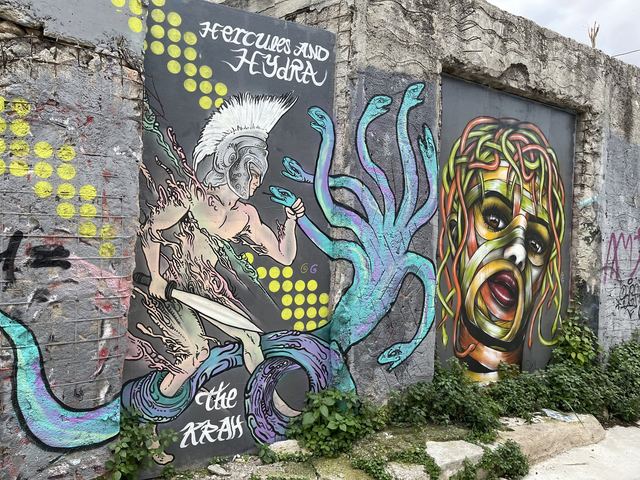 Our photo walkAthens Street Art: the walls worth the walkMythical heroes, giant figures and a wall of cats: the murals of Psyrri, Plaka and the centre.
 The back storyFrom Kerameikos to the opera by the sea: how Athens became a city of the artsFrom the potters’ quarter of Kerameikos to a modernist brewery turned national museum and Renzo Piano’s opera house by the sea: how Athens became one of Europe’s liveliest art cities.
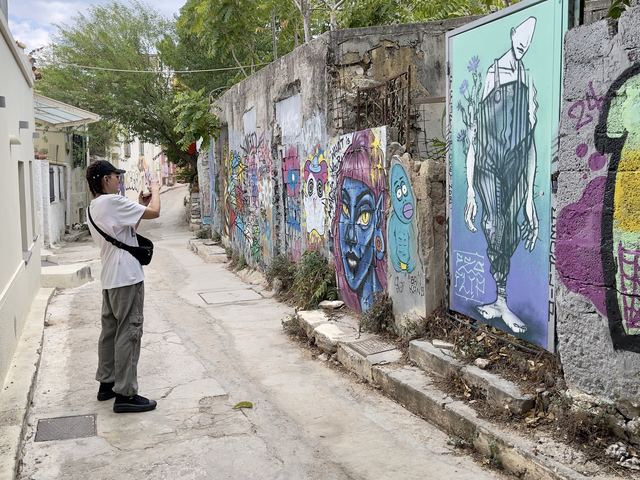 Jelena Bibić’s street-art walksJelena Bibić’s Athens: the painted walls of PsyrriThe artist JEKA walks Psyrri, Kerameikos and Plaka, reading the murals for colour, scale and nerve.