Attractions · 20 of the best in Athens
Lycabettus Hill
Best city view

About Lycabettus Hill
Rising like an island out of the sea of white buildings, Lycabettus is the hill every Athenian knows and loves: a pine-covered rock with a little white chapel on its summit and the best view of the city, from the Acropolis all the way to the sea.
A rock dropped by a goddess
Lycabettus is a steep limestone peak about 277 metres high, the highest hill in the heart of Athens, rising straight out of the city just north-east of the Acropolis. The ancient Athenians had a charming explanation for its strange, sudden shape: the goddess Athena was carrying a mountain from Pallini to raise the Acropolis higher when a crow brought her bad news, and in her shock she let the rock fall, right where it still stands.
The origin of the name is uncertain; one popular explanation links it to the Greek word for wolf, from the days when wolves roamed its wild slopes. In antiquity the hill lay outside the city walls, a rugged landmark rather than a sacred site, and it stayed largely bare and rocky for most of its history.
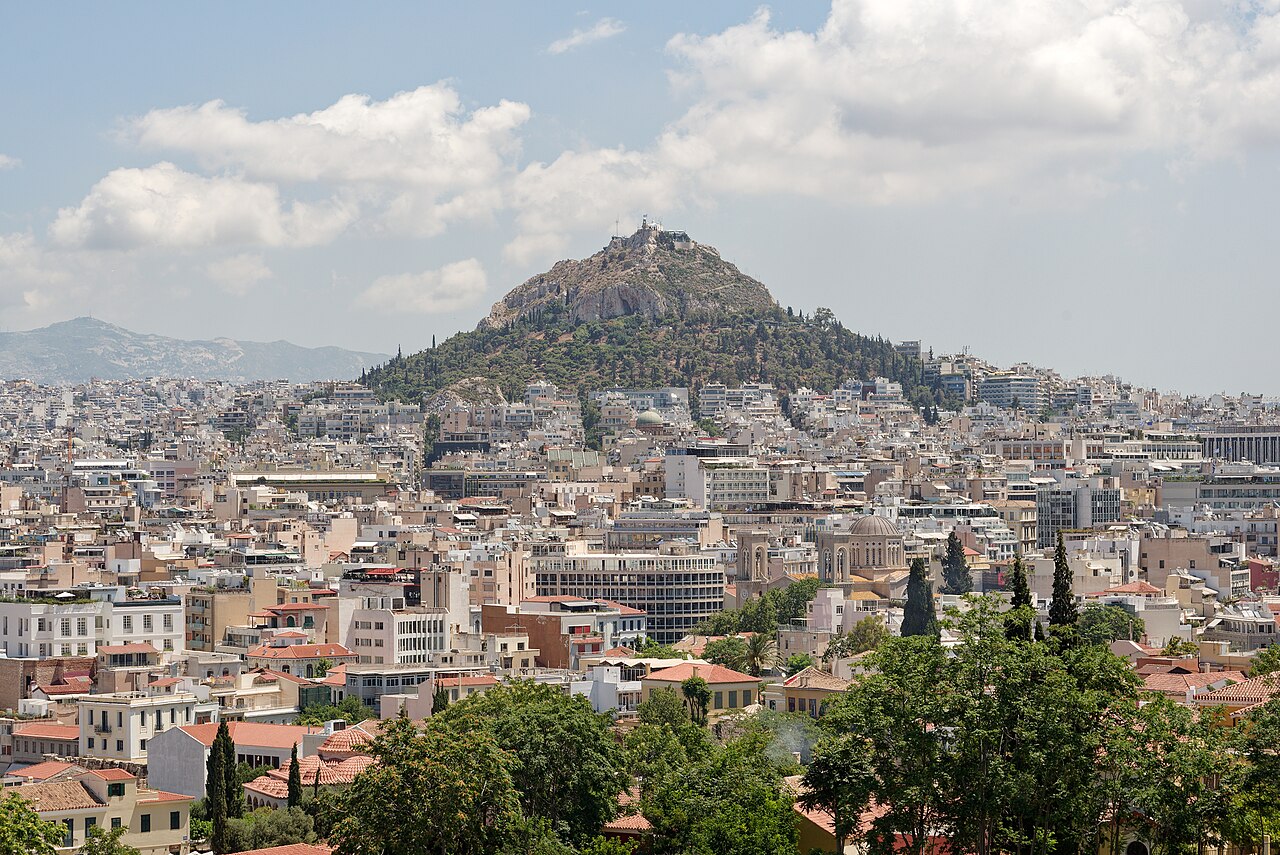
The origin of the name is uncertain; one popular explanation links it to the Greek word for wolf, from the days when wolves roamed its wild slopes.
Quarries, pines and chapels
When Athens became the capital of the new Greek state in 1834, Lycabettus was quarried for the stone that built the neoclassical city below. Quarrying scarred its slopes until it was stopped, and from the late 19th century the bare rock was planted with the pines that now cover the hill and make it one of the greenest, most peaceful places in central Athens.
At the summit stands the small white chapel of St George, Agios Georgios, built in the 19th century, and lower down, on the western slope, the old chapel of Agioi Isidoroi is tucked into a cave. On Good Friday the chapel’s procession winds down the hill by candlelight, one of the most moving Easter sights in Athens.

The funicular and the theatre
Since the 1960s a funicular has carried visitors from Aristippou Street in Kolonaki up through a tunnel in the rock to just below the summit, a ride of a few minutes. Around the same time, the actress Anna Synodinou leased one of the old quarries on the hill and commissioned the architect Takis Zenetos to design an open-air theatre there. The Lycabettus Theatre became one of the great summer stages of Athens, with decades of concerts by Greek and international stars.

After about fifteen years of closure, the theatre was renovated by the City of Athens, with new seating for nearly 4,000 people, and reopened in September 2023. Summer concerts under the stars are back on Lycabettus, and there are few lovelier places to hear live music on a warm night.

The view
The real reason to climb is the view. From the terrace by the chapel the whole of Athens spreads out around you: the Acropolis and the Parthenon to the south-west, the Panathenaic Stadium and the National Garden, the white sea of apartment blocks running down to Piraeus, the Saronic Gulf and, on a clear day, the islands of Salamis and Aegina. Behind you rise Mount Hymettus, Penteli and Parnitha, the mountains that ring the Attic plain. It is breathtaking.
Visiting
You can walk up from Kolonaki on paths and steps through the pines in about 30 to 40 minutes; it is steep in places, so wear good shoes and take water, and avoid the midday heat in summer. Or take the funicular from the top of Aristippou Street, a short, steep walk from Kolonaki Square. Entry to the hill is free, and there is a café and a restaurant near the top.

Our favourite time is sunset, when the marble of the Acropolis turns gold and the lights of the city flicker on below you. It is popular, so arrive early to find a spot along the wall. Early mornings are quieter and cooler, and the light over the city and the sea is beautiful too.
Why it's on our list
- The highest point in central Athens, about 277 m
- 360-degree views from the Acropolis to the sea
- The chapel of St George at the summit
- Funicular from Kolonaki, or a walk through the pines
Lycabettus at a glance
Check the funicular’s hours and the theatre’s summer programme before you go.
Getting up · 3
Funicular from Aristippou Street, Kolonaki, Walk up through the pines: about 30 to 40 minutes, Free entry to the hill
At the top · 4
Chapel of St George, Viewing terraces, Café and restaurant, Lycabettus Theatre, summer concerts
Opening hours, prices and seasonal openings change, so please check with Lycabettus Hill before you go.