Attractions · 20 of the best in Athens
The Acropolis & Parthenon
UNESCO World Heritage

About The Acropolis & Parthenon
Rising above the rooftops of Athens, the Acropolis has been the city’s sacred rock for more than three thousand years. Its temples, built in a single generation in the 5th century BC, are among the most influential buildings in the world, and seeing the Parthenon glow in the evening light is a moment you never forget.
The sacred rock
The Acropolis is a flat-topped limestone rock rising about 150 metres above sea level in the heart of Athens, with sheer sides on all but its western approach. People lived and worshipped here from the Neolithic period, and in the Bronze Age it was a fortified Mycenaean citadel. In time it became the sanctuary of Athena, the city’s beloved patron goddess.
In 480 BC the Persian army sacked Athens and burned the temples on the rock. For a generation the Athenians left the ruins as a memorial. Then, after victory and with the wealth of their maritime alliance, the statesman Pericles launched one of the most ambitious building programmes of the ancient world, and the Acropolis we know today was born.

In 480 BC the Persian army sacked Athens and burned the temples on the rock.
The golden age
The Parthenon was built between 447 and 432 BC, designed by the architects Iktinos and Kallikrates under the artistic direction of the sculptor Pheidias. Made of marble from Mount Pentelikon, it is full of subtle refinements: its columns swell slightly and lean inwards, and its floor curves gently upwards, so that the whole building looks perfectly straight and almost alive. Inside stood Pheidias’s colossal statue of Athena in gold and ivory, surrounded by the sculpted frieze, metopes and pediments that are among the greatest treasures of Greek art.
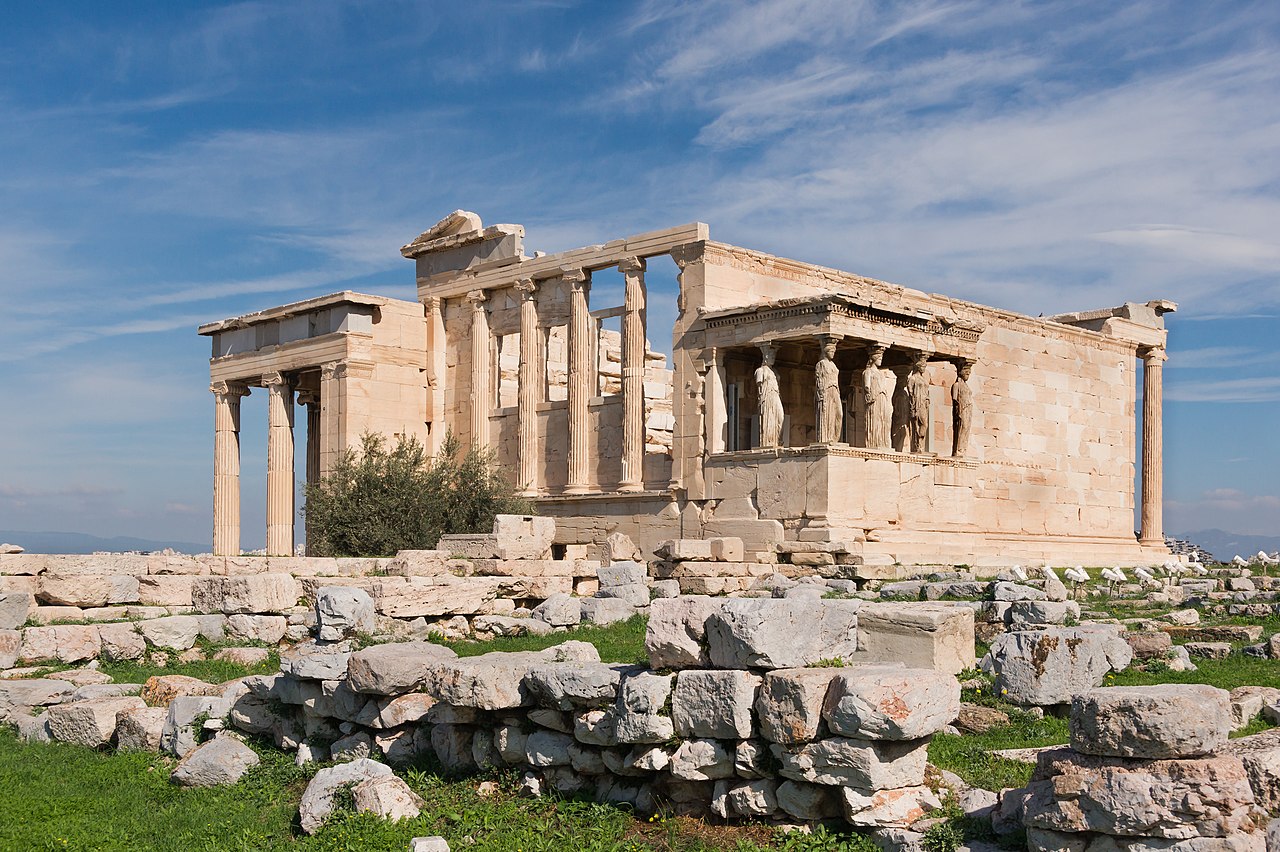
Around it rose the Propylaia, the monumental gateway designed by Mnesikles; the small, graceful Temple of Athena Nike on its bastion; and the Erechtheion, an unusual temple built on several levels around the oldest cults of the rock. Its porch of the Caryatids, six maidens carved as columns, is one of the loveliest sights in Athens.

Church, mosque and explosion
The monuments survived remarkably well for two thousand years. In late antiquity the Parthenon became a Christian church, under the Ottomans a mosque, and the Acropolis a fortress. Then, in 1687, came disaster: a Venetian army besieging the Ottoman garrison fired on the Parthenon, then used as a gunpowder store, and the explosion blew out its centre and destroyed much of the sculpture.
In the early 19th century, agents of Lord Elgin removed a large part of the surviving sculptures, which are now in the British Museum in London. Greece has long asked for their return, and in the Acropolis Museum the frieze is displayed with the London pieces shown as casts, waiting for the day they come home.
Restoring the Acropolis
After Greek independence the later buildings were cleared away to reveal the classical monuments. Since 1975 a dedicated restoration service has been patiently dismantling, repairing and rebuilding the temples, replacing old iron clamps that rusted and cracked the marble, and moving the original sculptures indoors to protect them, which is why the Caryatids on the Erechtheion today are copies; five of the originals are in the Acropolis Museum. In 2025 the Parthenon was seen without its scaffolding for the first time in decades, a wonderful sight, though conservation work continues.

Visiting today
The Acropolis is one of the most visited sites in the world, with more than four and a half million visitors in 2025, so a little planning goes a long way. Entry is by timed ticket, best bought in advance on the official Hellenic Heritage website, hhticket.gr, and the main entrance is on Dionysiou Areopagitou, the pedestrian promenade below the rock; a second entrance by the Acropolis Museum is often quieter. Arrive at opening time or in the late afternoon, wear shoes with good grip on the worn marble, and bring water and a hat; in heatwaves the site may close at midday. A lift on the north side helps visitors with limited mobility.
Make a day of it with the Acropolis Museum at the foot of the rock, the Theatre of Dionysus and the Odeon of Herodes Atticus on the south slope, and then a stroll up Filopappou Hill opposite for the classic view of the Parthenon at sunset. It is one of our favourite evenings in Athens.

Opening hours, prices and seasonal openings change, so please check with The Acropolis & Parthenon before you go.