Attractions · 20 of the best in Athens
Philopappos Hill
The finest Acropolis view

About Philopappos Hill
Ask Athenians where to see the Parthenon at its most beautiful and many will point you here, to the pine-covered hill just across from the Acropolis. Philopappos Hill is free, peaceful and full of history, from the birthplace of democracy to a Roman prince’s tomb, and at sunset, with the marble glowing gold across the valley, it is one of the most magical places in the city.
The Hill of the Muses
Rising about 147 metres above sea level, just south-west of the Acropolis, Philopappos Hill was known in antiquity as the Mouseion, the Hill of the Muses, said to be the place where the poet Musaeus sang and was buried. Together with its neighbours, the Pnyx and the Hill of the Nymphs, it forms a green, rocky parkland right in the heart of the city, scented with pine and wild herbs, where the noise of the traffic fades away within a few minutes’ walk.
Its position made it strategically important. The ancient city walls ran across it, and in 294 BC the Macedonian king Demetrius Poliorcetes built a fortress on the summit to keep watch over Athens. Centuries later, in 1687, Venetian forces besieging the Ottoman garrison on the Acropolis are said to have set up their guns on this hill; the bombardment ignited the gunpowder stored in the Parthenon and blew out its centre.

Only part of it survives, but it still dominates the skyline, and it gave the hill its modern name.
A Roman prince on the summit
The monument on the top is the tomb of Gaius Julius Antiochus Epiphanes Philopappos, a prince of the lost kingdom of Commagene, in what is now south-east Turkey, who became a Roman consul and a generous citizen of Athens. When he died, his marble mausoleum was built here between AD 114 and 116, facing the Acropolis, its curved façade decorated with statues of Philopappos and his royal ancestors and a frieze showing him as consul in his chariot. Only part of it survives, but it still dominates the skyline, and it gave the hill its modern name.

Democracy, Socrates and the stars
On the neighbouring Pnyx, the citizens of ancient Athens gathered in the assembly to debate and vote, and it was here that statesmen such as Pericles and Demosthenes addressed the people from a speaker’s platform cut into the rock, which you can still see. Standing there, with the Acropolis in front of you, it is easy to imagine the birth of democracy.
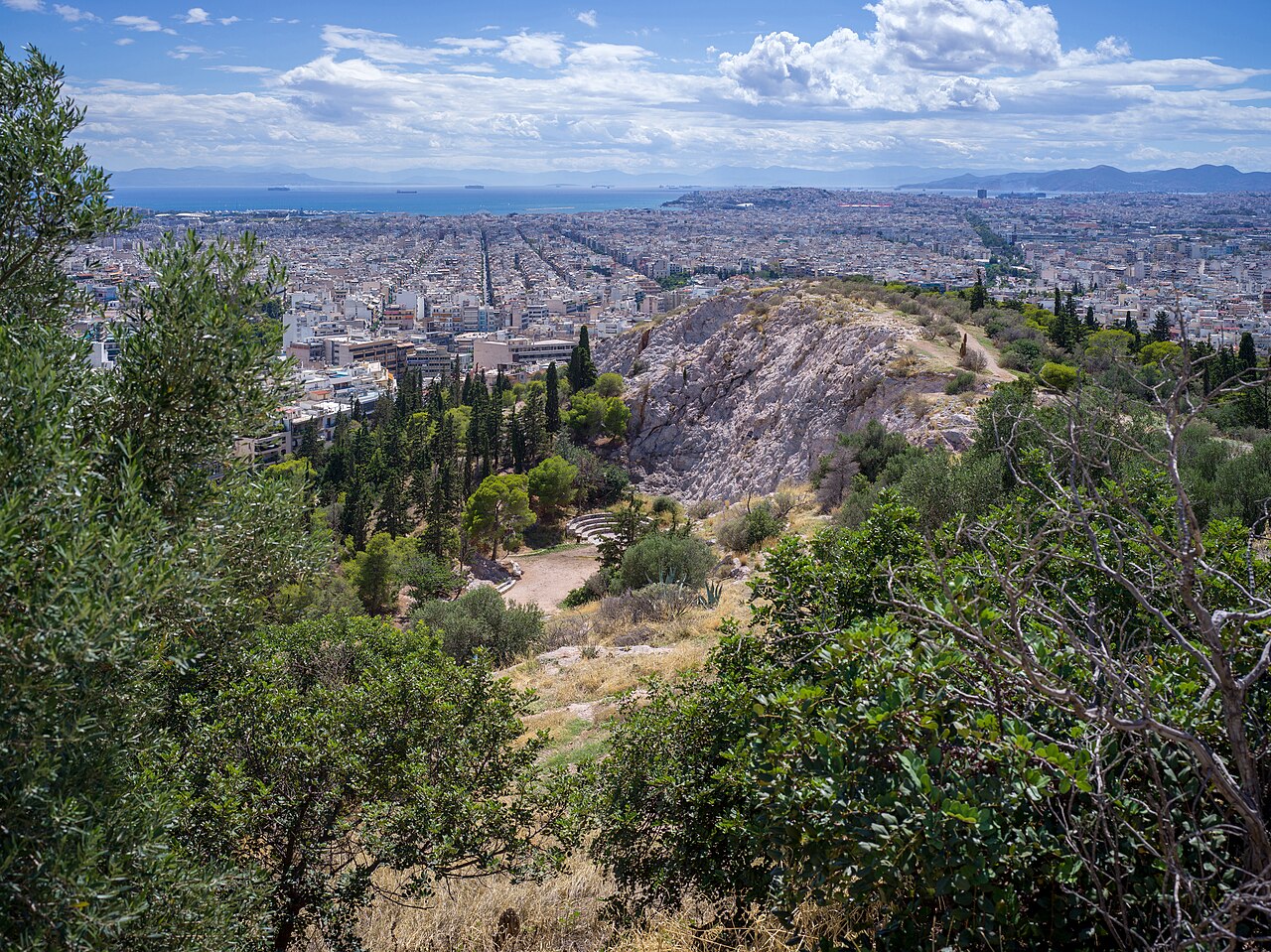
On the lower slopes, a set of rooms carved into the rock is traditionally known as the Prison of Socrates, although there is no evidence that the philosopher was held there; during the Second World War, antiquities from the Acropolis were hidden in these chambers for safekeeping. Above, on the Hill of the Nymphs, stands the neoclassical National Observatory of Athens, designed by Theophil Hansen in the 19th century.

Pikionis and his paths
The paths you walk on are a work of art in themselves. Between 1954 and 1957 the Greek architect Dimitris Pikionis landscaped the approaches to the Acropolis and Philopappos, laying winding paths of stone and marble fragments that seem to grow out of the hillside, with benches, viewpoints and a little café pavilion. He also restored the small church of Agios Dimitrios Loumbardiaris near the entrance, whose name recalls a legend of an Ottoman cannon, the lumbarda, struck by lightning before it could fire on the church. Pikionis’s work is considered one of the masterpieces of 20th-century landscape architecture.
The view, and when to go
From the summit the whole of Athens opens out around you: the Parthenon directly across the valley, close enough to pick out the columns, Lycabettus and the mountains beyond, and the city running down to Piraeus and the shimmering Saronic Gulf. It is a favourite spot for photographers, and many people think it is a better place to admire the Acropolis than the Acropolis itself.

Our advice: the main entrance is on Dionysiou Areopagitou, the pedestrian promenade opposite the Acropolis, a short walk from Akropoli and Thissio metro stations. The climb to the monument takes about 15 to 20 minutes. The marble paths are uneven and polished smooth in places, so wear shoes with good grip, and take water in summer, as there is little shade near the top. Sunset is magical but popular, so arrive early for a spot; early mornings are cool, quiet and beautiful too. Entry is free.
Why it's on our list
- Perhaps the finest view of the Parthenon in Athens
- The 2nd-century Roman monument of Philopappos
- The Pnyx, where Athenian democracy met
- Paths designed by Dimitris Pikionis
- Magical at sunset
Philopappos Hill at a glance
The paths are uneven and slippery in places; wear good shoes and take water in summer.
Getting there · 4
Entrance on Dionysiou Areopagitou, opposite the Acropolis, Akropoli and Thissio metro stations, About 15 to 20 minutes’ walk to the summit, No ticket needed
On the hills · 5
Philopappos Monument, The Pnyx, Prison of Socrates, Church of Agios Dimitrios Loumbardiaris, National Observatory on the Hill of the Nymphs
Opening hours, prices and seasonal openings change, so please check with Philopappos Hill before you go.