Objects of Desire
A hotel reborn, a tower that waited: the new architecture of Athens
The 1963 Hilton reborn as The Ilisian, Piraeus Tower, Renzo Piano’s hill and a museum garden.
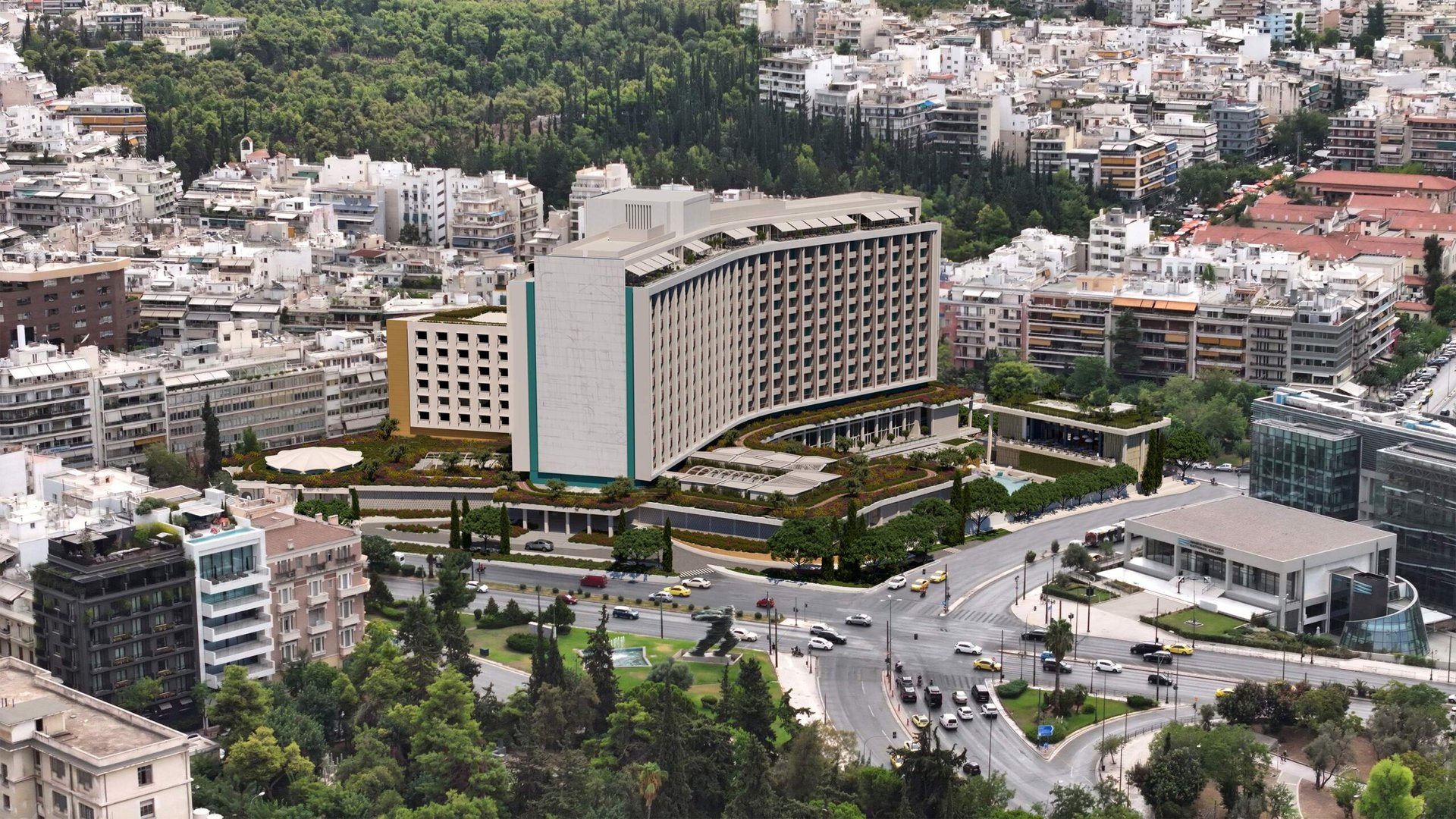
Photo Credit
Image courtesy of © The IlisianWhat does a city of ancient monuments build next? Athens has answered with reinvention rather than demolition: a 1960s hotel turned into a hotel and homes, an abandoned harbour tower brought back to life, a park lifted over an opera house and a museum about to grow a garden. Here are the buildings worth seeing, from the developers’ and architects’ own pages, checked in November 2026. No prices, only buildings.
The Hilton becomes The Ilisian
When it opened in 1963, the Hilton at Ilisia wore façades by the artist Yiannis Moralis, and it housed the Hilton Athens for more than half a century. As The Ilisian, the building keeps those façades and takes on Hilton’s Conrad and Waldorf Astoria brands: a new Conrad hotel and 55 homes, 18 Conrad Residences and 37 Waldorf Astoria Residences.
The developer’s renderings show residents sharing a pool landscape and a green roof above the Ilisia rooftops. It is reinvention by addition rather than subtraction: the marble reliefs stay where Athenians have always seen them, and the life behind them changes.
The tower that waited
Down at the port, the Piraeus Tower stood abandoned for nearly half a century above the ferry quays. DIMAND brought it back as what it calls the first green and digital high-rise in Greece, with the highest LEED Platinum certification: 22 floors and 88 metres of offices, shops, a gym, a wellness area and places to eat and drink, in an award-winning design by PILA Studio.
DIMAND calls it the starting point of the Athenian Riviera. Seen from a ferry at dusk, it is also the first building to welcome you back from the islands, which is a great deal of responsibility for an office block.
Lifting the land
At the Stavros Niarchos Foundation Cultural Center, Renzo Piano’s idea was topographic. Poseidonos Avenue had cut the city off from the sea, so he proposed to lift a piece of land into a sloping park and place the buildings beneath it, so that from the top you regain the lost view of the sea and the Acropolis.
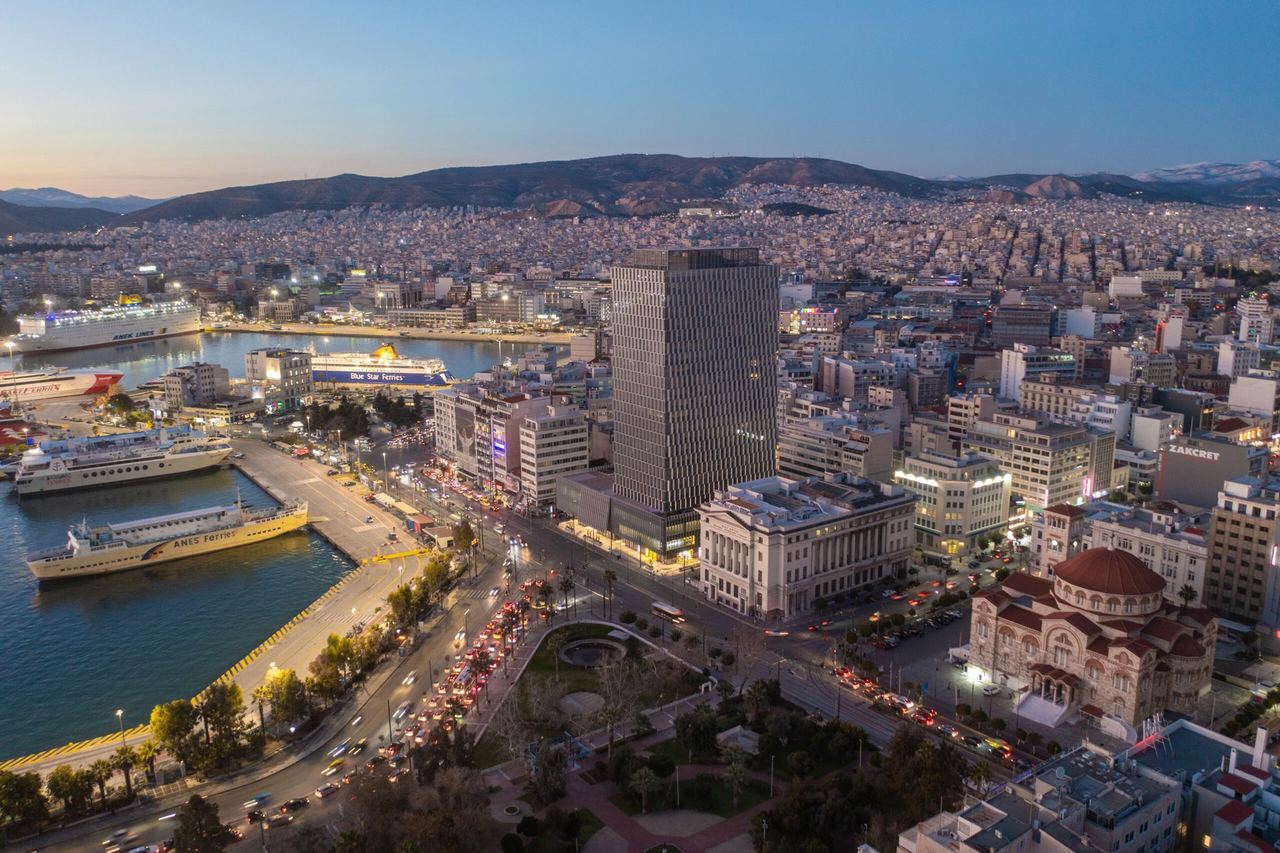
Photo Credit
Image courtesy of © DIMANDThe park covers 85% of the site, planted with olives, carobs, laurels, cypresses and Greek aromatic plants. The Greek National Opera’s new home covers 28,000 square metres, and above it sits the glass Lighthouse under the “Magic Carpet”, an energy-producing canopy of solar panels. Few opera houses wear their power supply as a hat.
Few opera houses wear their power supply as a hat.
From the glass Lighthouse the view runs across Athens, Piraeus and the Saronic Gulf. The National Library of Greece has its building in the same complex, with more than a million books, periodicals and rare manuscripts from the 9th to the 20th century, so the city’s books and its opera now share a hill that did not exist twenty years ago.
The next great project will be green on top. At the National Archaeological Museum, built between 1866 and 1889 to designs by Ludwig Lange and Ernst Ziller, David Chipperfield Architects plan to extend the plinth to the street, adding roughly 20,000 square metres, including two floors of galleries beneath a raised garden by Wirtz International.
Inside the old building, a new Classical Hall is to crown the sequence of sculpture, and the annex built in 1930 by George Nomikos is to become a research centre with a library, laboratories and study collections, alongside better earthquake resilience and a stable indoor climate for the works.
That garden is planned with gravel paths, lawns, umbrella and Aleppo pines and holm oaks around a sunken courtyard, with rammed-earth walls in the galleries below. Our advice: walk the Stavros Niarchos Park at sunset for the view Piano went looking for, and for The Ilisian’s residences, contact the developer through its own site.
Why it's on our list
- The Hilton becomes The Ilisian
- The tower that waited
- Lifting the land
Location
The map comes from Google Maps, which sets its own cookies once it loads.
More in depth
 Objects of DesireThe Daiquiri, by the book: three ingredients and the Athens bars that respect themThe IBA’s three-ingredient Daiquiri, and the Syntagma bars that take rum and the classics seriously.
 Objects of DesireLess parked than crouched: the electric Jaguar and the new supercarsJaguar’s Type 00 and Type 01, Ferrari’s first electric car and the record-breakers around them.
 Objects of DesireFive see-through cars and a spiral of wheels: the Hellenic Motor MuseumA collector’s 110-plus cars near Victoria, five see-through ones, and the showrooms up north.